Portable UV-Vis Spectrophotometer compatible with Liquid/Solid/Thin-film samples. Upgradable to fluorescence and dip probe for continuous monitoring
Plastic has become ubiquitous and their recycling has become essential. Therefore in order to achieve reusability in society, TestRight offers its spectroscopic devices for effective material recycling with an aim to save natural resources, energy and money.
Background
The industry is looking for the type of material recycling technology that is most effective and can save natural resources and energy. And that is where Testright steps in. With advancements over the recent years, spectroscopic analysis has become a common method in identifying different kinds of plastics. And with its PRIZM range of spectrometric devices, Testright provides the latest solution to the industry woes
Testright's Devices
PRIZM FLUORO FLUOROMETER
Specifications :
- During a study, researchers measured the diffused reflectance of several plastic samples: PETE (polyethylene terephthalate), often used in containers and clothing; the thermoplastic LDPE (low-density polyethylene); PP (polypropylene), which has numerous everyday applications; and PS (polystyrene), which is heavily used in packaging and containers.
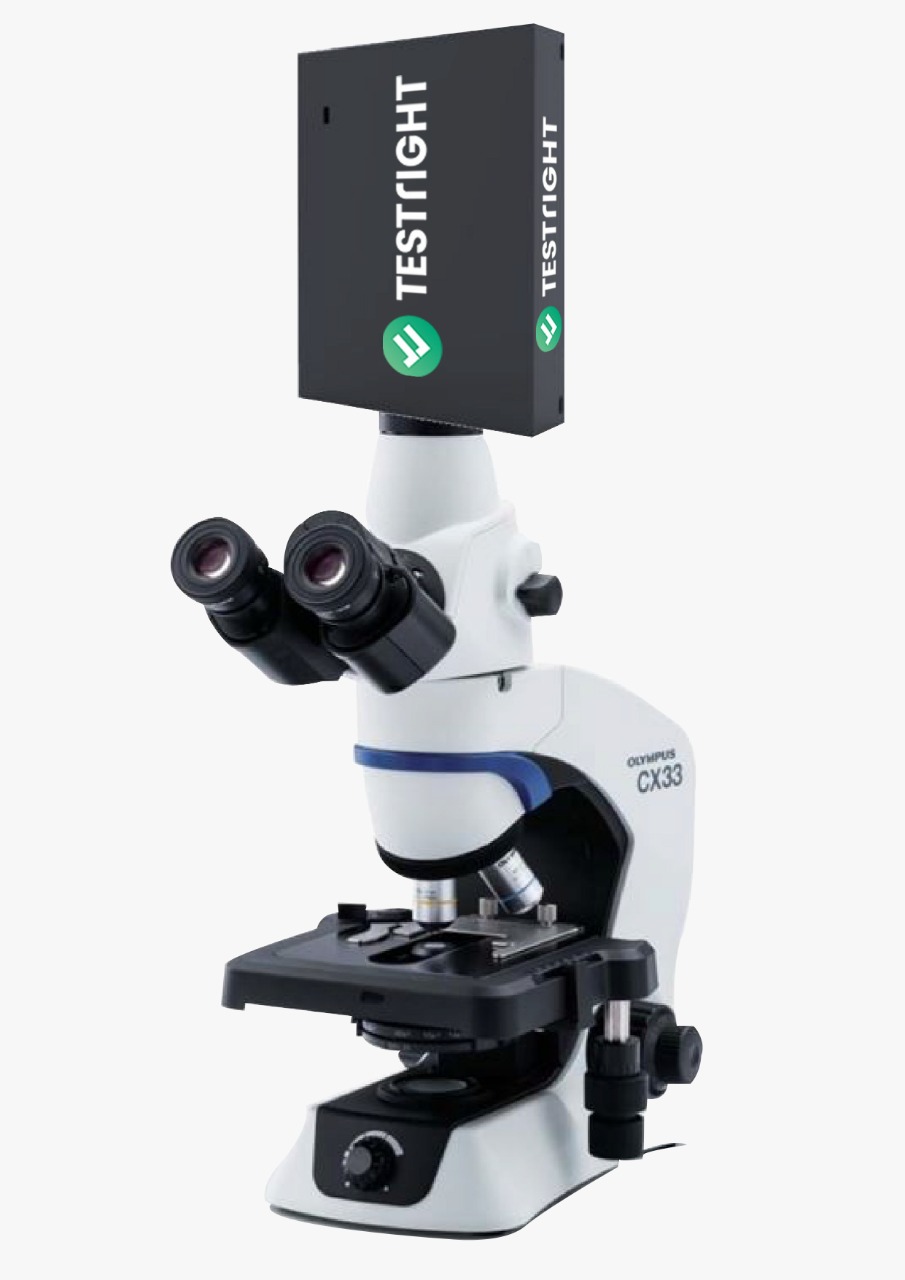
- And this can be easily achieved by Testright’s advanced and affordable range of PRIZM ABS spectrophotometers.
- The devices come with kinetics, full-spectrum, and OD modes, and are equipped with portable units, making them fit in confined spaces.
- They operate on back-thinned CCD- array technology, making the device portable, compact, and long lasting as they have no rotating parts.
- Along with providing simultaneous scanning at all wavelengths within 1 sec, they also report directly in g/L, ppm, etc, and are compatible with flow cells. The devices are compatible with smartphones, enabling field applications. Testright also provides free software upgradation and remote support.
Research Observation
Specifications :
- After acquiring the data in absorbance mode, log(1/R) of the reflectance spectra was plotted, with R being the reflectance of the sample as shown in Fig.1.
- Also, the reflectance spectra for chemical analysis by taking log(1/R) of the reflectance spectrum, allowed the researchers to see concentration as scaling with signal intensity.
- Furthermore, measurements were taken for plastic samples (PET and PP) using a high-power tungsten halogen light source, 600 µm reflection probe, and diffuse reflectance standard.
- The parameters were set at 5 ms integration time, with 25 scans to average and boxcar width set to 1. And the results were obtained as %Reflection as shown in Fig.2.
- This proved that indeed, NIR spectra provide a wealth of information about the plastic samples, provided we have the tools to extract that data.
- An excellent example is the Principal Component Analysis, a chemometric analysis method that can be applied to the data collected to group and classify the samples by type using their spectral signature. This helps in making useful decisions in the process of plastic sorting
RAMAN SPECTROSCOPY IN PLASTIC SORTING
Specifications :
- Prizm Raman is a unique instrument that combines the advantage of a portable probe system with the performance of a highly specified laboratory instrument. It is a perfect choice for Raman analysis when the acquisition of high-quality data is essential.
- With fast acquisition within 5 seconds for most samples, it comes with an electronic shutter enabled 0.1ms-60s integration time, sturdy body, and customized laser power.
- Available with 532, 785, and 1064 nm laser excitation, it provides superior sensitivity with low noise. It has a built-in high-speed mini USB for full control of the spectrometer and is supported by the software SpectroSmart, making it compatible with all systems operating on Windows, Ubuntu, or Android.
- In the recycling industry where accurate sorting of massive amounts is required, the application of Raman spectroscopy has great advantages, like:
(1) no reference signal is required;
(2) surface conditions and H2O and CO2 in the air or on the surface have fewer effects;
(3) the signal to noise ratio (SNR) is easily achieved by a pumping laser. It can also help in measuring the appropriate SNR spectrum and identify plastics with multivariate analysis in less than 1.5 milliseconds. - These advantages make Raman measurements more robust to changes in sample characteristics.
Research Observtion
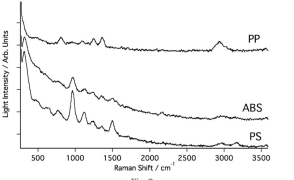
- Fig.3 shows the robustness of the Raman spectra of PP, PS and ABS with characteristic peaks with good SNR, with a measurement time of 6ms.
- In all spectra there are peaks around 3000cm-1, which are attributed to the stretching of CH or OH bonds that all plastic has. Styrene’s (PS and ABS) and PP are distinct by the peak for ring breezing in benzene structure, and the peak around 1000cm-1.
- For Styrene, the apparent peak of CN-stretching around 2250cm-1 makes it possible to decide on PS or ABS that are not distinguishable in the commonly used NIR. Multivariable analysis successfully helps to distinguish plastic components and makes it possible to classify quality from the resulting values of discrimination analysis.
Conclusion
Testright's PRIZM range of spectrometers and classification models have been proved reliable in detecting different grades of plastics. And through the use of modular spectroscopy components and spectral data, measurements could be taken outside the lab environment which can help recyclers streamline the plastics-sorting processes. And by making operations more efficient and cost-effective, the plastic industry can contribute to a more sustainable environment.